 Health
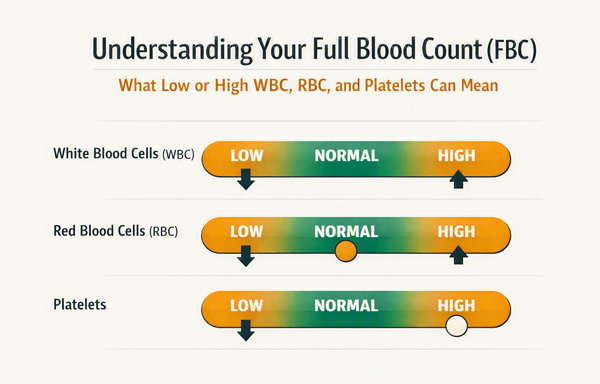
Understanding Your Full Blood Count (FBC): What Low or High WBC, RBC, and Platelets Can Mean
The Full Blood Count — sometimes called a Complete Blood Count (CBC) — is probably the most commonly ordered lab test there is. It's often the first thing a doctor checks, whether you're feeling unwell, going for a routine check-up, or being monitored for an existing condition. But an FBC report is dense: a page full of abbreviations and numbers that can feel more confusing than reassuring. Here's what the three big ones — White Blood Cells, Red Blood Cells, and Platelets — actually tell you.
What is a Full Blood Count?
An FBC measures the three main types of cells that make up your blood: white blood cells (your immune defenders), red blood cells (which carry oxygen), and platelets (which help your blood clot). Each is reported as a count, and each has its own "normal" range — so it helps to look at them one at a time rather than trying to read the whole report at once.
White Blood Cells (WBC): your immune system's headcount
What it measures: the number of white blood cells in your blood — your body's infection-fighting cells.
Typical range: roughly 4,000–11,000 cells/µL (often written as 4.0–11.0 x10⁹/L).
What a high WBC can mean: most commonly, it means your immune system is actively responding to something — an infection (bacterial or viral), inflammation, physical stress, or even something as simple as a recent workout or emotional stress can raise it temporarily. Certain medications, particularly steroids, also raise WBC count. Less commonly, a very high or unusual WBC pattern can point toward a blood disorder, which is why doctors sometimes ask for a "differential" — a breakdown of the specific types of white cells — when the total count is notably elevated.
What a low WBC can mean: this can happen with certain viral infections, some autoimmune conditions, vitamin deficiencies, or as a side effect of medications that suppress bone marrow activity (including some chemotherapy drugs). A low WBC count can mean your body has a reduced ability to fight off infection, so it's usually worth a conversation with a doctor rather than a wait-and-see approach.
Red Blood Cells (RBC), Hemoglobin, and Hematocrit: your oxygen carriers
What it measures: the number of red blood cells, and how much oxygen-carrying capacity your blood has. RBC count is usually read alongside hemoglobin (the oxygen-carrying protein) and hematocrit (the percentage of blood made up of red cells) — the three move together.
Typical range: RBC count and hemoglobin differ by sex — roughly 4.7–6.1 million cells/µL for men and 4.2–5.4 million cells/µL for women, with hemoglobin around 13.5–17.5 g/dL for men and 12.0–15.5 g/dL for women.
What low RBC/hemoglobin (anemia) can mean: this is one of the most common abnormal findings on an FBC. Common causes include iron deficiency (often diet-related, or from blood loss such as heavy menstrual periods), vitamin B12 or folate deficiency, chronic disease, or in some cases parasitic infections. Anemia often shows up alongside fatigue, pale skin, or shortness of breath — if you've been feeling unusually tired, a low RBC/hemoglobin result is one of the first things worth investigating.
What high RBC (polycythemia) can mean: less common, and often linked to dehydration (which concentrates the blood and can be a false alarm — worth rechecking once well-hydrated), smoking, living at high altitude, or underlying heart/lung conditions that reduce oxygen levels and prompt the body to produce more red cells to compensate. Rarely, it can reflect a bone marrow condition.
Platelets: your clotting cells
What it measures: platelets are small cell fragments that clump together to stop bleeding when you're injured.
Typical range: roughly 150,000–450,000 platelets/µL (150–450 x10⁹/L).
What a low platelet count (thrombocytopenia) can mean: in many parts of the world, including Nigeria, one of the most common causes of a temporarily low platelet count is malaria — it's worth mentioning specifically here because it's such a frequent, usually self-limiting cause. Other causes include viral infections like dengue, certain medications, autoimmune conditions, or bone marrow issues. A mildly low platelet count during or shortly after a febrile illness is common and often resolves once the underlying infection clears — but a very low count, or one accompanied by unusual bruising or bleeding, needs prompt medical attention.
What a high platelet count (thrombocytosis) can mean: often a reactive response to infection, inflammation, iron deficiency, or recovery after surgery or injury — the body temporarily produces more platelets as part of a normal response. Less commonly, a persistently high count unrelated to any of these triggers can point to a bone marrow condition and is worth further evaluation.
Reading the whole picture, not just one line
The real value of an FBC is in how the three results relate to each other. For example: low platelets plus low WBC during a fever points strongly toward a viral or malarial cause; low hemoglobin with normal WBC and platelets points more toward a straightforward nutritional anemia. This is exactly why doctors — and a well-built interpretation tool — look at the full panel together rather than reacting to a single flagged line in isolation.
What to do with your FBC result
- Don't fixate on one abnormal line before seeing the rest of the panel. A single mildly off value is common and often explained by something temporary — a recent infection, dehydration, or normal day-to-day variation.
- Note anything going on around the time of the test — a recent illness, fever, medication, or heavy menstrual period can all explain a result and are useful information for a doctor.
- Get significant abnormalities checked promptly, especially a very low WBC or platelet count, or hemoglobin low enough to cause symptoms like breathlessness or dizziness.
- Track it over time if you can. A value that's stable over several tests tells a very different story than one that's trending steadily in one direction — trends are often more informative than any single number.
An FBC packs a lot of information into a small table, but you don't need to memorize what every abbreviation means to get value from it — understanding the three big categories (WBC, RBC/hemoglobin, platelets) and roughly what pushes each one up or down covers most of what matters. As always, a lab value is a starting point for a conversation with a doctor, not a diagnosis on its own.
Want to understand your lab results?
Upload your lab report and get a clear explanation in seconds.
Get started free →